Real papers. Honest citation checks.
LitMark finds real academic papers for your assignment question, highlights the exact sentence that's relevant, and checks each citation in your essay against its source, so you can catch a bad one before you submit.
Find real sources
Search 7 academic databases and get real papers, with the exact relevant sentence highlighted. Name an author and their papers come first. Ask about a statistic or a law and you also get the official figure or the Act's wording, taken straight from the source.
7-day free trialFor & against
See evidence that supports your argument and evidence that challenges it, side by side, before you commit to a position.
7-day free trialPlan
Enter your assignment question and word count. Get a one-page Word plan: the key reviews to read first, the most cited papers and an outline with a word budget and a customised search for each subheading, one click to run it in LitMark.
7-day free trialCheck your citations
Paste your essay and each citation is checked against its abstract and, for some open-access papers, parts of the full text. Each is tagged faithful, overstated, misrepresented, fabricated, retracted or challenged, not original source, or unable to verify, with a Citation Accuracy score. Check the source before relying on a verdict.
7-day free trialDatabase search
Turn your question into a ready-to-paste Boolean search for the database your course uses: PubMed, Scopus, Web of Science, Cochrane, EBSCOhost, Ovid, ProQuest, JSTOR, Google Scholar, Westlaw or Lexis+. Synonyms and that database's own field tags are included. You paste it into the database to run it.
7-day free trialSave & export
Save papers to folders, sorted automatically by the question they came from and kept in your account, so they're there on any device you log in on. Copy a bibliography in APA, Harvard, MLA, Chicago, Vancouver or IEEE, download a folder as Word or PDF, or get a summary of what a saved paper offers for your question.
7-day free trialHit the Mark
Paste your assignment rubric and see which criteria your draft appears to cover, which it's missing, and real papers to fill evidence gaps.
7-day free trialLitMark never writes a word of your essay.
LitMark supports your research, not your writing. Its AI helps with summaries and plain-English explanations of papers you've saved, plan headings, search queries and explaining its own results, always as research help for you to read, never as text to paste into your essay. Your argument and your wording stay yours. Check your university's rules on using AI tools for research and planning.
Real papers for the question you actually asked.
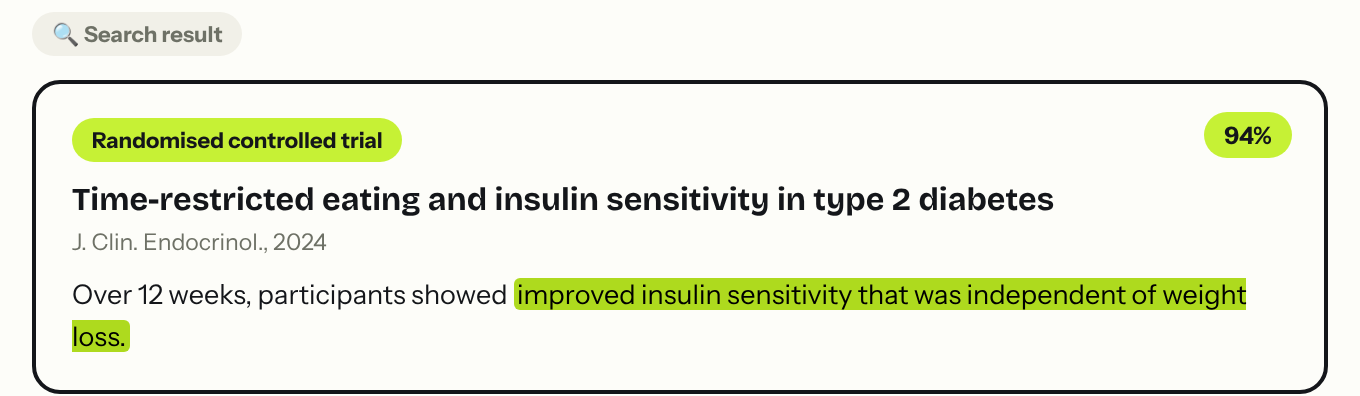
Type your assignment question in plain English and LitMark searches 7 academic databases, surfacing the exact relevant sentence in each result — so you're not skimming forty abstracts to find the one that matters.
See both sides before you commit to an argument.
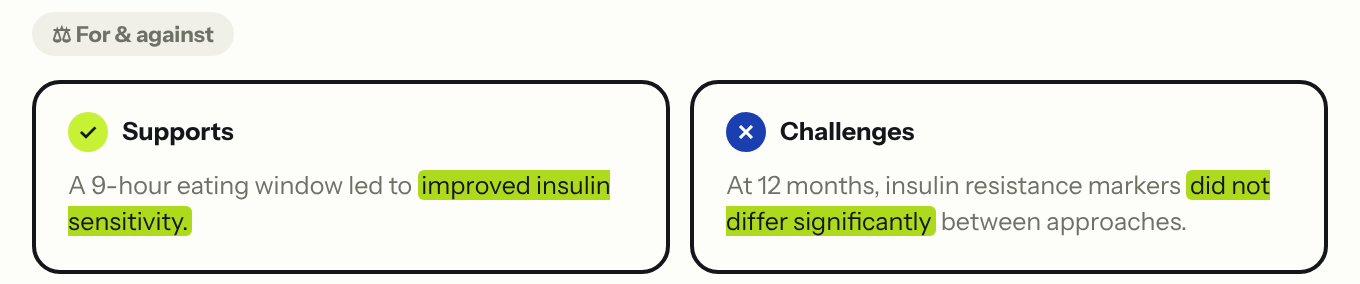
Each question is searched twice, once for evidence that supports it and once for evidence that challenges it, side by side — so your essay engages with the real debate instead of quietly cherry-picking the sources that agree with you.
A plan for your assignment, not a draft.
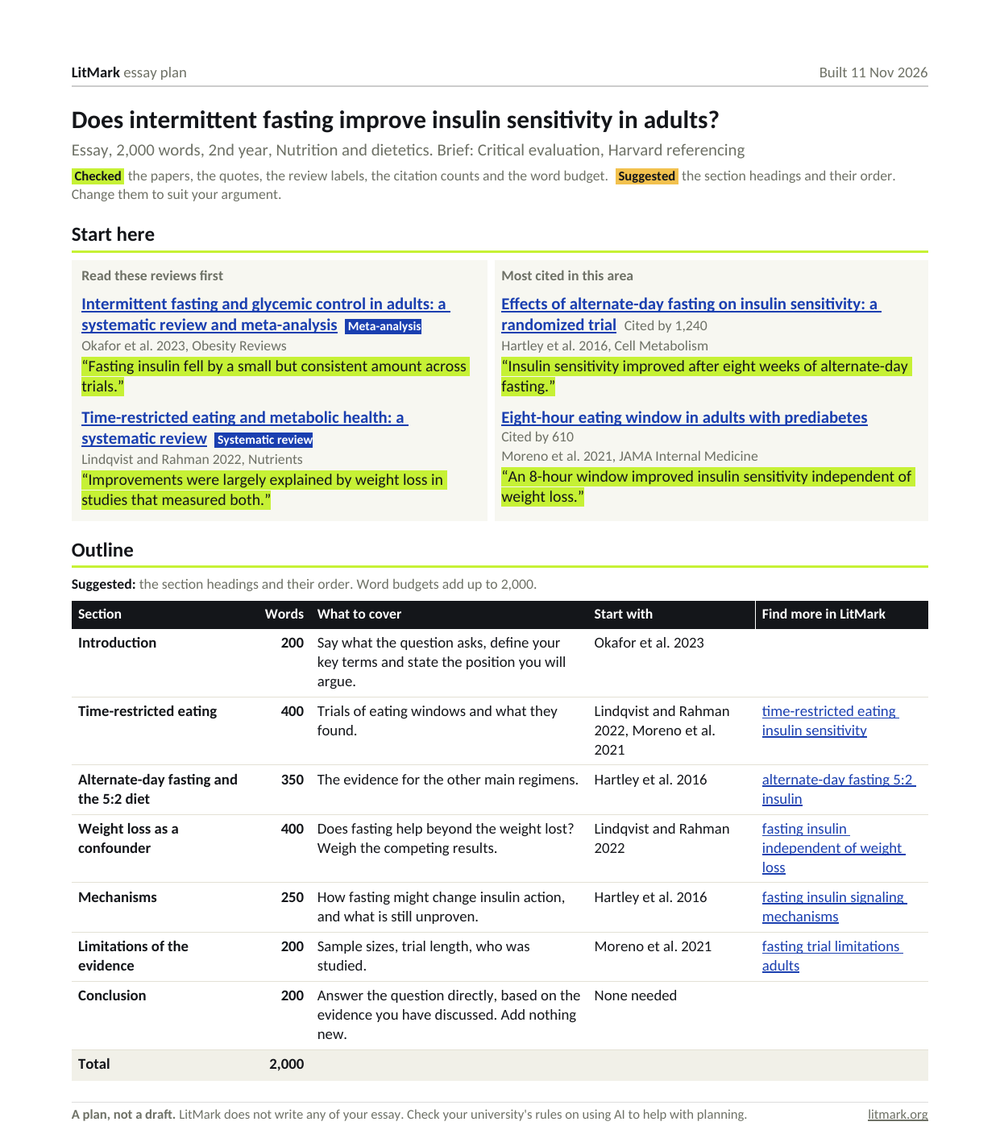
Enter your question, the type of assignment, your word count and your year. LitMark gives you a one-page Word plan: the key reviews to read first, the most cited papers in the area with a checked quote from each, and a suggested outline with a word budget and a customised search for every subheading, one click to run it in LitMark. It's a plan, not a draft. LitMark never writes a word of your essay.
Save it once. Export it however your course wants it.
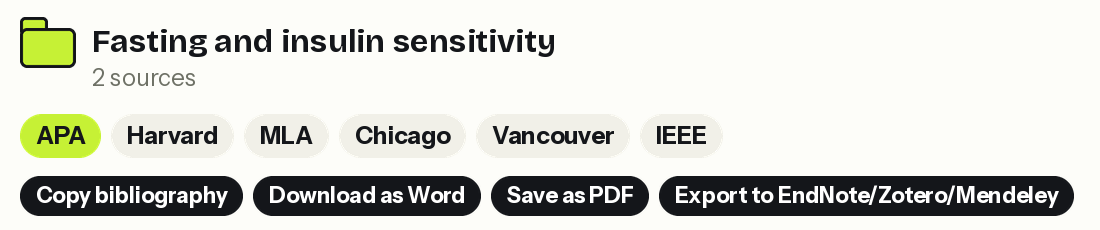
Every folder tracks APA, Harvard, MLA, Chicago, Vancouver and IEEE at once — copy the bibliography, download as Word or PDF, or export straight to EndNote, Zotero or Mendeley. Your folders are saved to your account, so they follow you to any device.
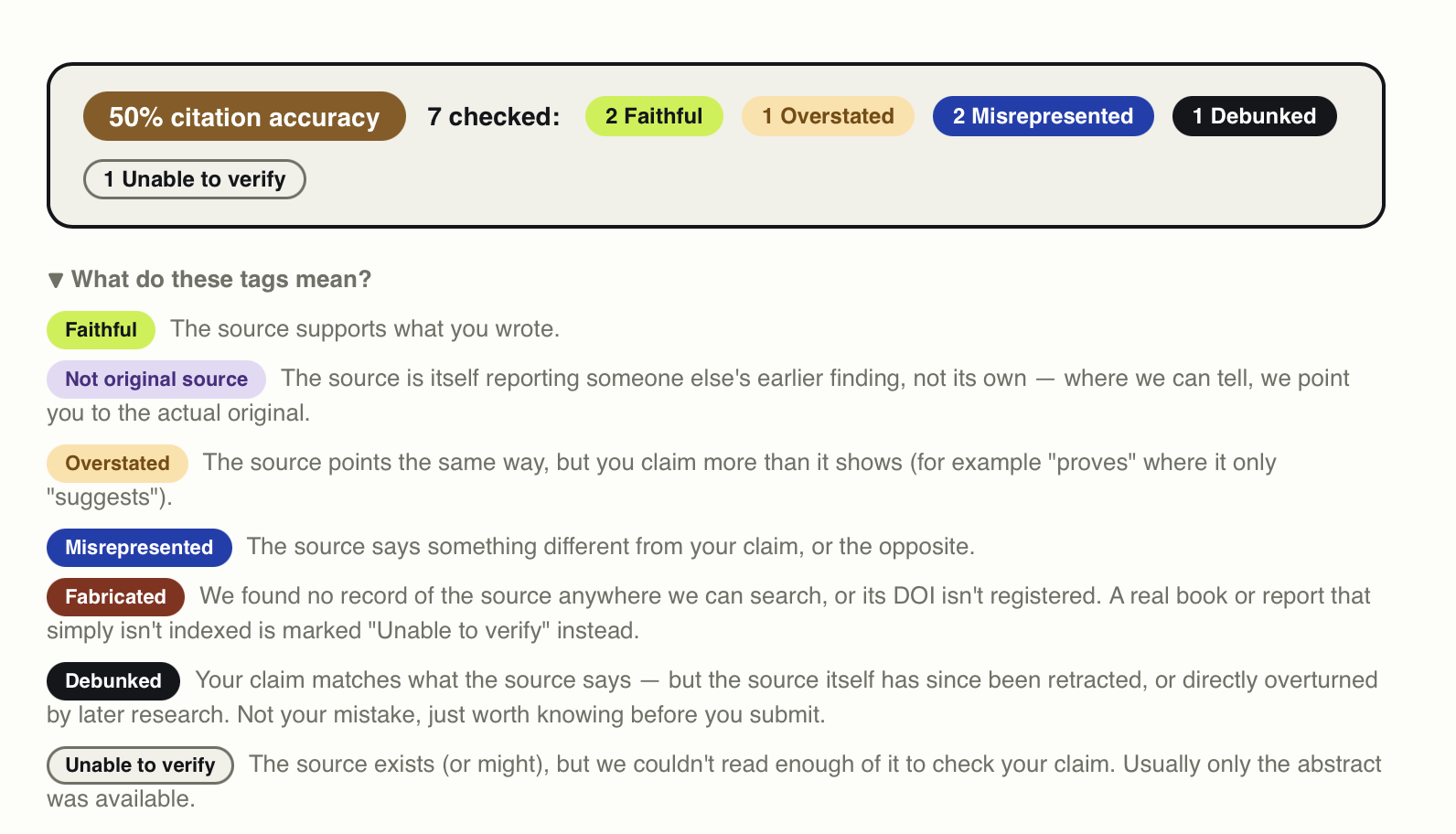
Catch a fake citation before your tutor does.
Paste your essay in. Each citation is checked against its source, using the abstract and, for some open-access papers, parts of the full text, and tagged faithful, not original source, overstated, misrepresented, fabricated, retracted or challenged, or unable to verify. Then it's rolled into one Citation Accuracy score so you can see where you stand before you submit. Some sources can't be checked, and LitMark says so. Check the source yourself before relying on a verdict.
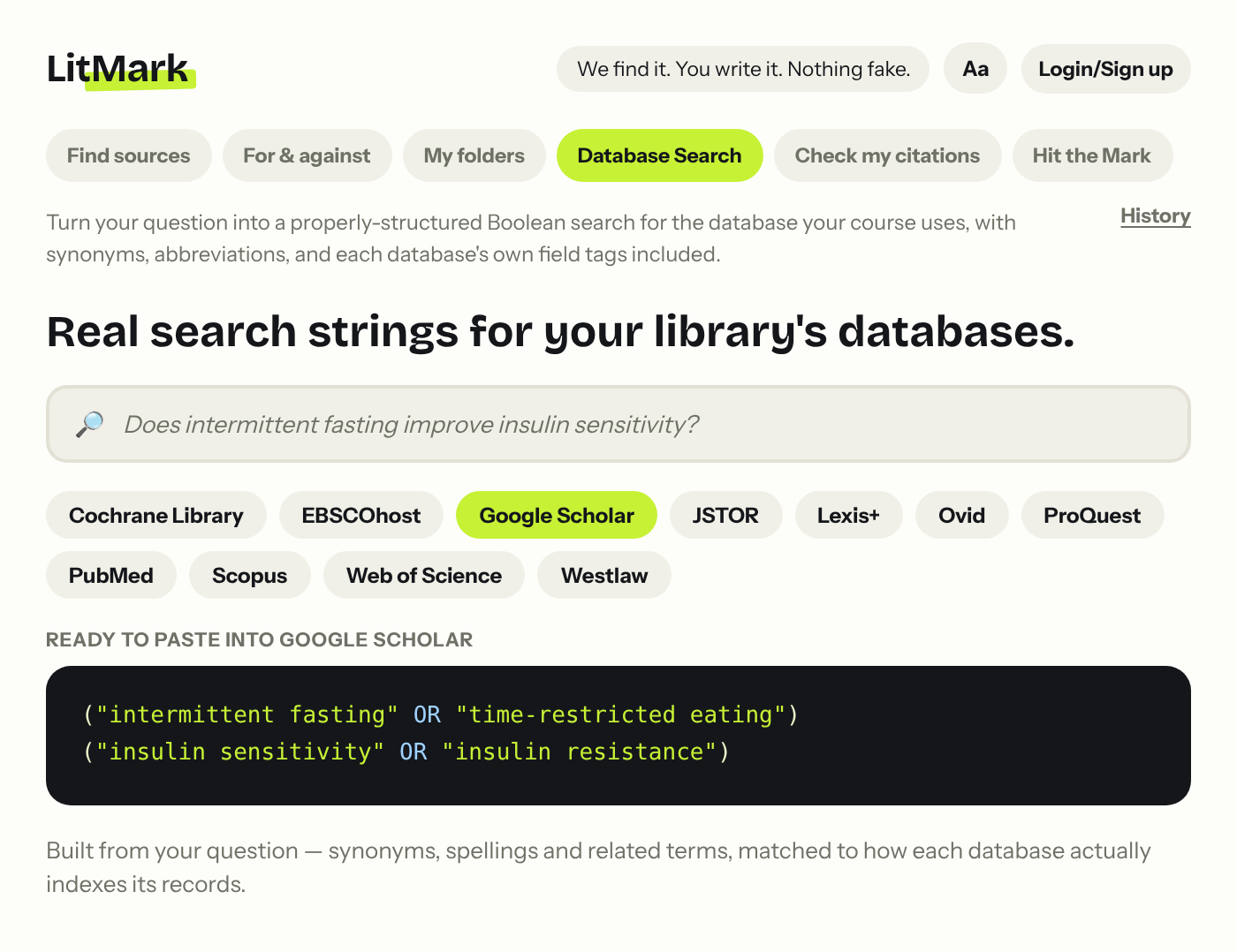
Search strings for your library's databases.
Built from your actual question — synonyms, spellings and related terms — ready to paste into PubMed, Scopus, Web of Science, Cochrane, EBSCOhost, Ovid, ProQuest, JSTOR, Google Scholar, Westlaw or Lexis+. LitMark writes the search. You run it in the database.
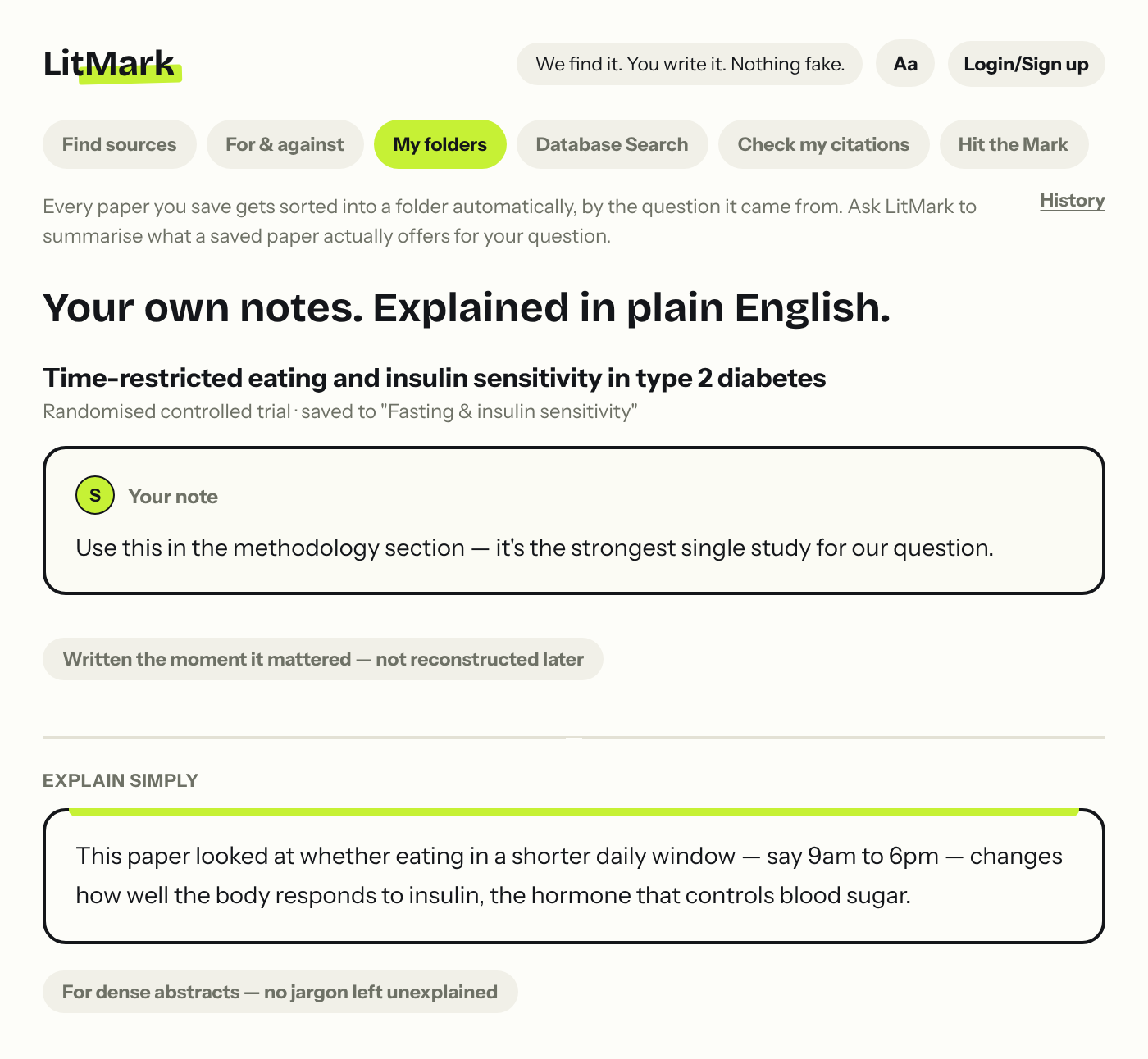
Write down why it mattered. Understand it in plain English.
Add a note the moment you know why a source matters, so you're not reconstructing your own reasoning weeks later. And for any abstract written in dense field jargon, get it explained in plain English — no jargon left unexplained.
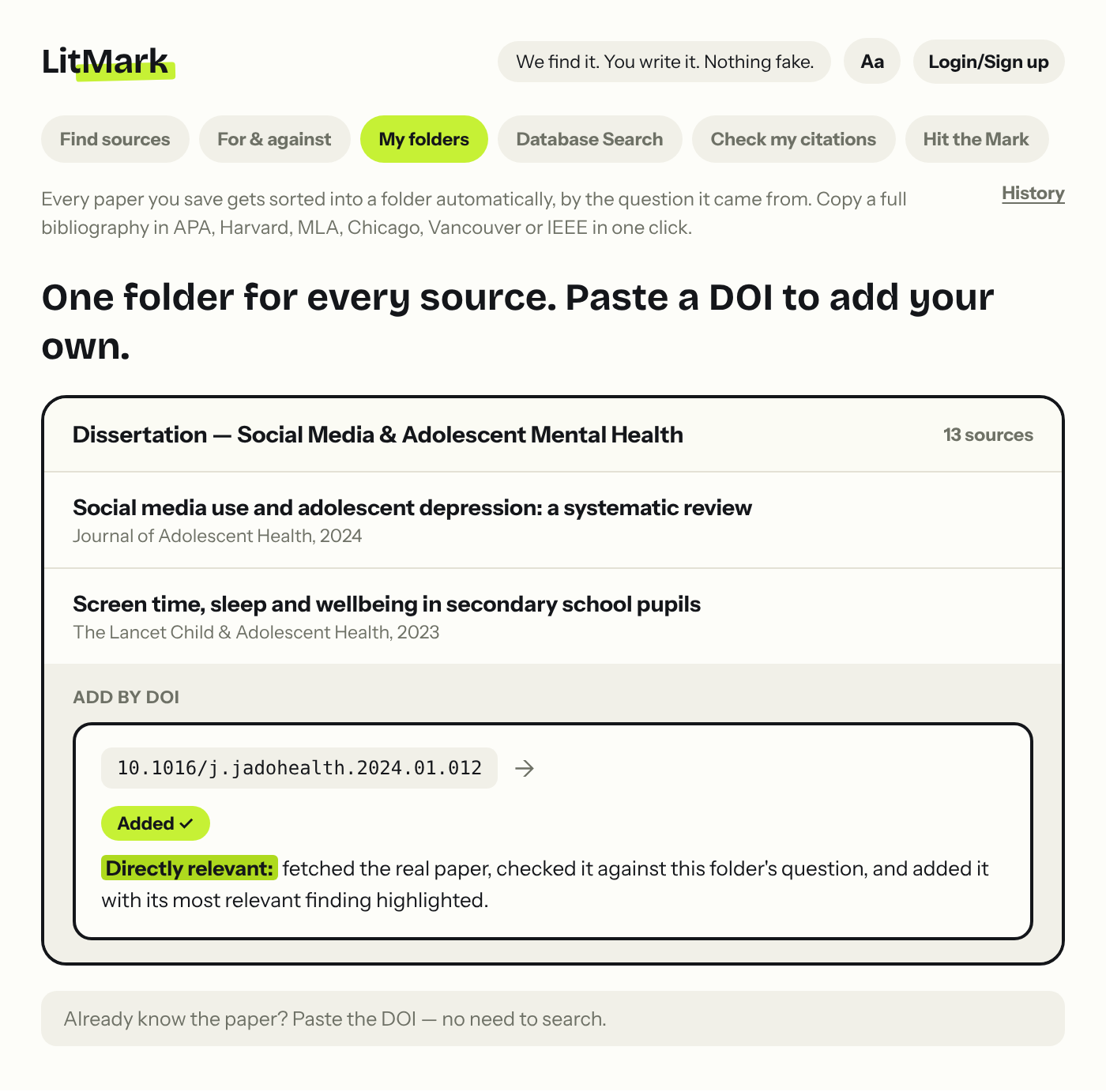
Every source for your assignment, in one folder.
Save sources straight from a search into a folder for that assignment, with your highlighted excerpt and notes kept alongside each one. Already know a paper you want to use, from a lecturer's reading list or somewhere else? Paste its DOI into the folder and LitMark fetches the real paper, checks it against your research question, and adds it with the same relevance highlight as everything else you've saved.
See which rubric criteria you've hit.
Upload your marking criteria and your essay, and every criterion comes back with a status — hit, partly there, or missing — plus a suggested next step. A missing piece of evidence pulls real papers to fill it; a missing citation routes straight to Citation Check. Never a predicted grade, just what LitMark can see in your draft and what to do about it.
